

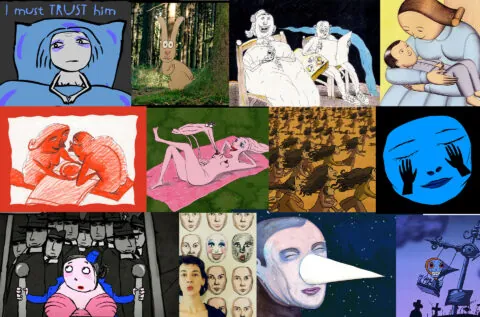
Films together + Portrait of the artist
In the landscape of contemporary animation, Czech filmmaker Michaela Pavlátová stands out not only for her expressive and stylistically diverse body of work, but also for her fearless commitment to depicting women’s lives through their desires and resistances. With a feminist perspective and a career spanning over three decades, Pavlátová has constructed a singular artistic voice. Her body of animated work, ranging from experimental shorts such as Words, Words, Words (1991) to her feature animated debut My Sunny Maad (2021)[1], offers a reflection on women’s intimacy, identity and gendered relations. As Chris Robinson (2022) observes: “Pavlátová’s beautifully designed films obsessively probe how language, boredom, sex, desire, and, of course, death inevitably mess up marriages and relationships”. The strength of her work lies not only in its aesthetic ingenuity, but also in its insistence on positioning animation as a serious medium for feminist storytelling. Based on an interview with the filmmaker, this article reflects on her artistic journey and examines how her work contributes to a feminist perspective in animated cinema.
THE SEEDS OF SUBVERSION
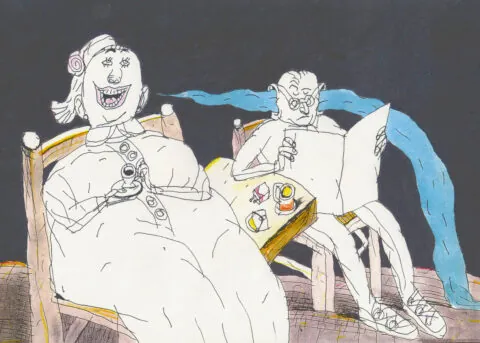
words, words, words
Pavlátová emerged as a filmmaker during the final years of state socialism in Czechoslovakia, a period marked by both artistic constraint and subversive experimentation, when live-action cinema often suffered from heavy censorship (Cammell, 2024). Originally, Pavlátová intended to study in the illustration department at The Academy of Arts, Architecture and Design in Prague (UMPRUM), but given the high level of competition and the seriousness that characterized the discipline, she turned to animation instead. “There was one very important meeting with the experimental Japanese animator Nobuhiro Aihara. Through a retrospective of his films, I discovered that animation could be much more than animation on cels. You could be free! Aihara gave me his old 8mm film camera, which allowed frame-by-frame shooting, and I suddenly had a tool to explore and create my own animations: it was a dream for me”. Her first animated film, now unfortunately lost, depicted people wearing different glasses that allowed them to see different things depending on the pair they wore.
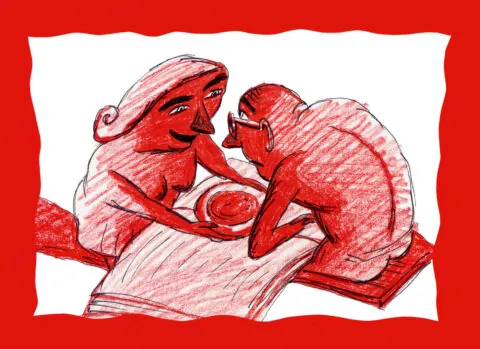
Repete
Through animation, Pavlátová found a space within cinema where she could express herself freely and fell in love with the medium. This early creative autonomy allowed her to explore themes that would later become central to her artistic practice. Words, Words, Words (1991), which was nominated for an Academy Award, uses playful yet biting visual metaphors to examine the absurdities and failures of human communication. It set the tone for a series of short films, Repete (1995), This Could Be Me (1996) and Forever and Ever (1998), that employ repetition, abstraction and surrealism to explore with the psychic routines of modern life shaped by heteronormative gender roles. These films are not explicitly didactic, but they pulse with quiet resistance. In Repete, couples go through choreographed loops of emotional and physical exchange, highlighting how desire can become mechanized within societal structures. Through spare yet evocative design and rhythmic editing, Pavlátová deconstructs the supposedly “natural” dynamics of gendered behavior.
REPRESENTING WOMEN’S SEXUAL AGENCY
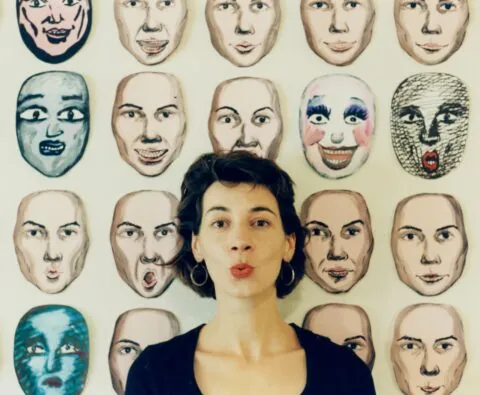
This Could Be Me
Before entering The Academy of Arts, Architecture and Design in Prague (UMPRUM), Pavlátová worked as an inbetweener at studio Bratři v triku. She recalls that, at the time, all directors were men and that women faced a situation similar to Disney’s: they were mostly assigned to lower tasks like coloring and inbetweening. But for Pavlátová, gender is not what defines a great animation director: “You need a perfect cocktail of skills: talent, discipline and patience”. She recalls that in the 1980s, gender parity was not a topic of discussion in the Czech Republic. “I always feel I disappoint journalists who want to hear how much I suffered as a woman filmmaker, but I did not. […] It’s ironic that communist countries, which were really bad in so many ways, somehow gave women more opportunities… but they also came with more duties”. She acknowledges that being a female artist is not easy. As a director, one must take on a leadership role, and this, she admits, has affected her personal relationships, where she was sometimes perceived as too dominant.
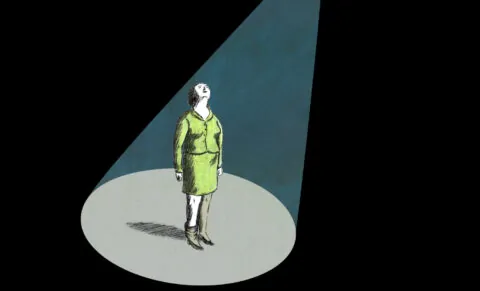
Carnival of Animals
Even though Pavlátová considers herself a feminist filmmaker, she notes that this perspective emerges unconsciously in her work. She believes her films have often been labeled as a feminist voice, but she never approached them with that intention. Pavlátová first encountered feminism in the early 1990s, after the opening of the Eastern Bloc. At the time, she recalls, feminism carried a negative connotation, and feminists were often stereotyped as old, unattractive women who couldn’t find a partner and had “no other choice” but to become feminists. Although she initially distanced herself from the label, she later came to recognize (through her university studies, experiences of divorce and travels as a woman alone) how essential feminism had been in advancing women’s rights. She moved from not wanting to be associated with a movement that was poorly perceived to fully embracing its significance and aligning herself with its values.
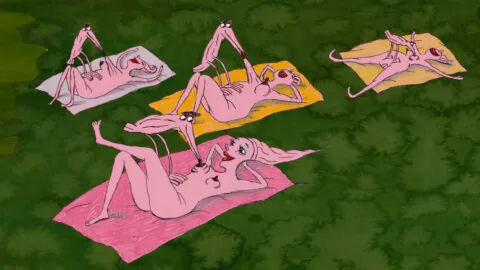
Carnival of Animals
What distinguishes Pavlátová from many of her contemporaries is the way she addresses sexuality and desire with both frankness and humor. Her groundbreaking 2006 Carnival of Animals functions as an erotic metaphor, offering not only a psychological portrait of desire, but also a cultural critique of its representation. Provocative and far from illustrative, the film is deeply conceptual and formally inventive. It reflects her evolving engagement with the lived experiences of women. “For me, the strongest moment of desire is before sex: imagining how it will be, dreaming about it. That anticipation is much more powerful than the act itself: it takes my breath away”.
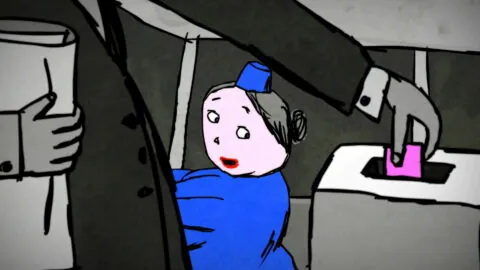
Tram
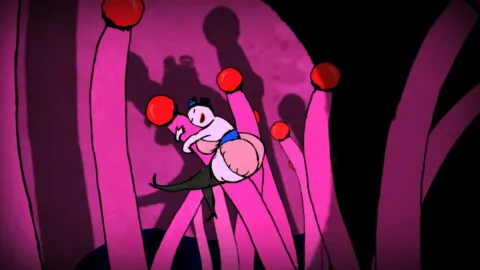
Her 2012 short Tram, which won the Cristal at Annecy, epitomizes her playful and uninhibited approach to sexuality. The film follows a female tram driver whose erotic daydreams animate an otherwise monotonous commute through the city. Through bold, stylized drawings and exaggerated motion, Pavlátová delivers a tour de force, portraying the protagonist’s sexual agency without ever objectifying her. The film is both playful and subversive, placing female sexuality and desire unapologetically at the center of the narrative. With Tram, rather than depicting desire through a male gaze (Mulvey, 1975), Pavlátová’s animation gives space to a woman’s interior fantasy life that is represented as loud and joyful. The filmmaker’s interest in the embodied experience of women is consistent throughout her work, even with difficult or culturally sensitive themes.
ANIMATED FEATURE FILM DEBUT
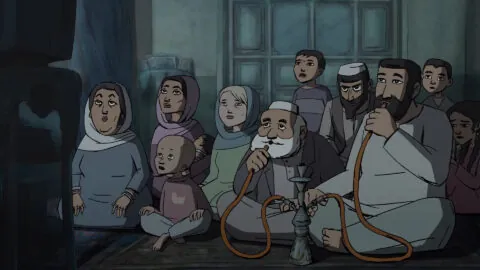
My Sunny Maad
With My Sunny Maad (2021), Pavlátová extended her feminist cinematic project to the feature-length format, marking a major milestone in her career. The film, based on Petra Procházková’s novel Frišta (Pond, 2022), follows Herra, a Czech woman who marries an Afghan man and discovers the complexities of life in a patriarchal society very different from her own. Though the film addresses cultural clashes, domestic oppression and post-war trauma, it never collapses into sensationalism. Her direction emphasizes nuance and contradiction, as the protagonist’s experiences are conveyed through intimate moments (caregiving, domestic tensions and subtle gestures of rebellion) rather than grand political statements. In an interview (Johnson, 2021), Pavlátová has stated that she chose animation because it softens difficult subjects, allowing viewers to engage emotionally with stories that might otherwise seem too distant or painful. My Sunny Maad was widely celebrated, earning the Jury Award at Annecy and a nomination for the Golden Globe for Best Animated Feature. The film demonstrates Pavlátová’s ability to expand her feminist concerns into more complex narrative structures.
AUTORSHIP AS FEMINIST LEGACY
Tram
As one of the most internationally recognized independent female animators, Pavlátová’s position in the field raises important questions about authorship. Her work foregrounds a feminist voice not only through content but also through form. Her body of work demonstrates how women’s stories are told differently when women themselves are behind the camera. She is currently in the first stages of production on her second animated feature film, Night Tram, that is based on Božena[2], the protagonist of Tram (2012). In this new film, Božena is no longer driven by sexual desire; she has entered a new stage of life, she is aging. Drawing inspiration from her own experiences, Pavlátová explores themes of bodily transformation, the social perception of older women and the subtle ways in which they are made to feel invisible in everyday life. Yet, as she notes: “It is a funny, positive film about aging”. As feminist animation continues to gain scholarly and critical attention, Pavlátová’s new film will undoubtedly occupy a central place within this evolving discourse. Once again, Pavlátová offers a protagonist who defies commercial representations of women, affirming animation’s power to portray female experience on her own terms. This creative commitment, however, comes at a cost: the financial structure of the film remains incomplete. Any producer reading this article would be well advised to consider international co-production for Night Tram which promises to be a profoundly significant and culturally resonant film about aging women.
[1] This article will not address her feature live action films Faithless Games (Nevěrné hry, 2003) and Night Owls (Děti noci, 2008).
[2] Božena is a Czech female name derived from Žena (woman) and Bůh (God), meaning “woman blessed by God”.
FILMOGRAPHY (ANIMATED FILMS)
Pavlátová, M. (1991). Řeči, řeči, řeči [Words, Words, Words] [Animated short film]. Krátký Film Praha.
Pavlátová, M. (1995). Repete [Animated short film]. Krátký Film Praha.
Pavlátová, M. (1996). To můžu být já [This Could Be Me] [Animated short film]. Independent.
Pavlátová, M. (1998). Až navěky [Forever and Ever] [Animated short film]. Krátký Film Praha.
Pavlátová, M., & Hlavatý, V. (2006). Karneval zvířat [Carnival of Animals] [Animated short film]. Česká televize.
Pavlátová, M. (2012). Tramvaj [Tram] [Animated short film]. Sacrebleu Productions & Negativ.
Pavlátová, M. (Director). (2021). Moje slunce Mad [My Sunny Maad] [Animated feature film]. Negativ, Sacrebleu Productions, BFILM.
BIBLIOGRAPHY
Cammell, L. (2024, September 24). Subversive shorts: How Eastern Bloc animators evaded Soviet censors. The Skinny. https://www.theskinny.co.uk/film/interviews/samizdat-film-festival-michaela-pavlatova
Johnson, R. (2021, October 29). Out of Afghanistan: Michaela Pavlátová on ‘My Sunny Maad’. Animation Magazine. https://www.animationmagazine.net/2021/10/out-of-afghanistan-michaela-pavlatova-on-my-sunny-maad/
Mulvey, L. (1975). Visual pleasure and narrative cinema. Screen, 16(3), 6–18. https://doi.org/10.1093/screen/16.3.6
Pond, S. (2022, January 20). ‘My Sunny Maad’: Making an animated film that doesn’t feel like animation. The Wrap. https://www.thewrap.com/my-sunny-maad-making-of-interview/
Procházková, P. (2004). Frišta. Nakladatelství Lidové noviny.
Robinson, C. (2022, October 17). Know your indie filmmaker: Michaela Pavlátová. Cartoon Brew. https://www.cartoonbrew.com/know-your-indie-filmmaker/know-your-indie-filmmaker-michaela-pavlatova-222225.html
[1] This article will not address her feature live action films Faithless Games (Nevěrné hry, 2003) and Night Owls (Děti noci, 2008).